Research
My research lies at the interface of computational statistical physics, soft matter, and biophysics. Using large-scale molecular simulations together with data-driven methods, I study how intrinsically disordered proteins organise themselves in space and time, and how their collective behaviour gives rise to biomolecular condensates through liquid–liquid phase separation.
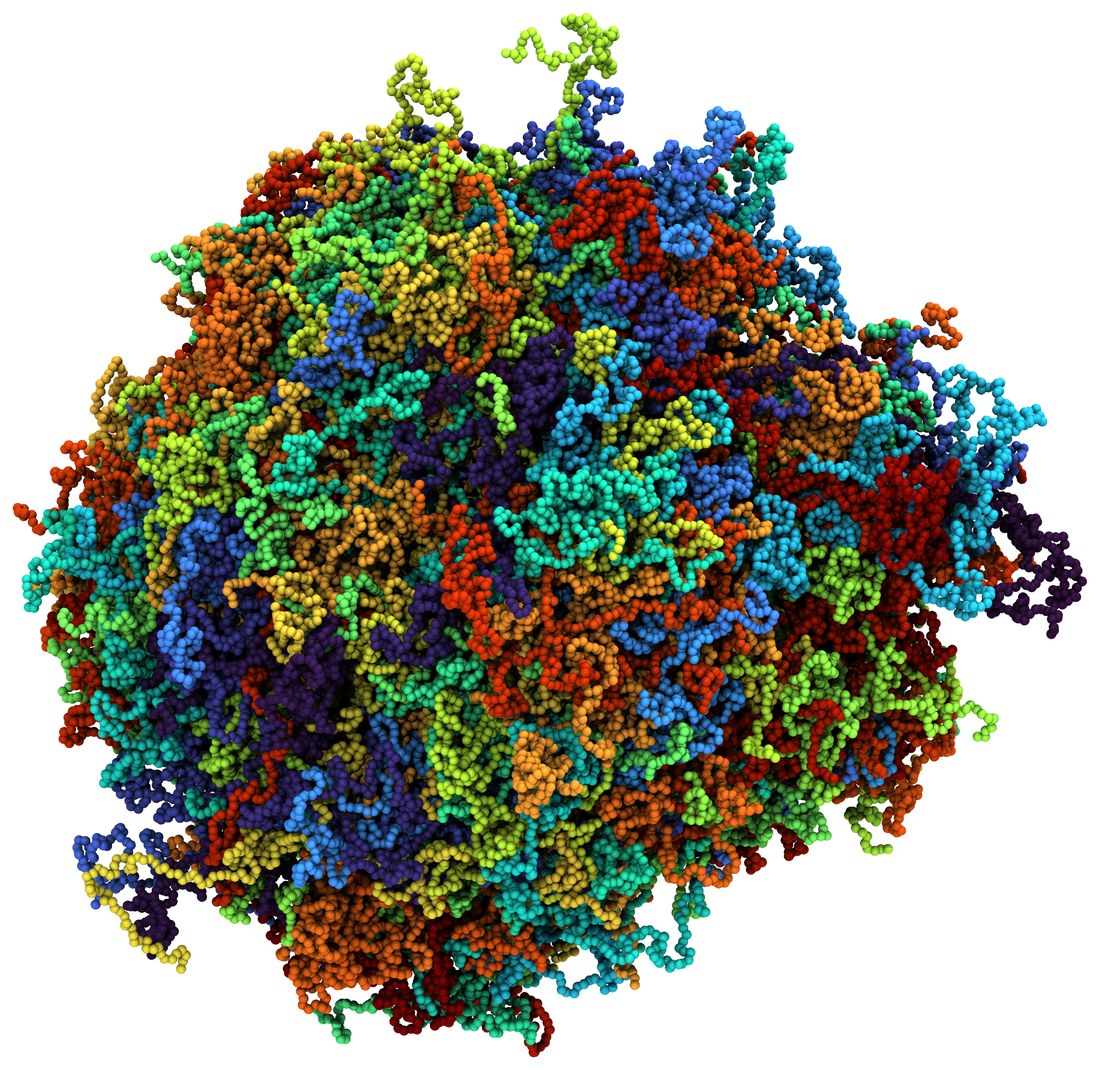
Research Themes
Computational statistical mechanics
Applying and developing computational methods of statistical mechanics — molecular simulations, enhanced sampling, and statistical analysis — to connect microscopic interactions to the collective, emergent behaviour of many-body systems.
Multiscale simulations
Developing and applying multiscale molecular-dynamics approaches, powered by high-performance computing, to reach the length and time scales needed to study condensates and disordered proteins.
Machine learning for complex systems
Using machine learning and data-driven analysis to extract collective variables, dynamics, and structure–property relationships from large simulation datasets of soft-matter systems.
Active matter
Statistical physics of active matter — self-driven, energy-consuming systems that operate far from equilibrium and give rise to collective motion and emergent, self-organised dynamics.
Approach & Methods
My work combines physics-based molecular simulation with modern data analysis. Typical tools and techniques include:
Selected Publications
A few representative works — see the full list on the Publications page.
- RGG motifs govern subcellular localization, condensation properties and RNA-binding of FUS — in preparation.
- On the dynamics of intrinsically disordered protein FUS — in preparation.
- Multi-Domain Interplay Controls Full-Length TDP-43 Phase Separation and Condensate Dynamics — bioRxiv (2026).